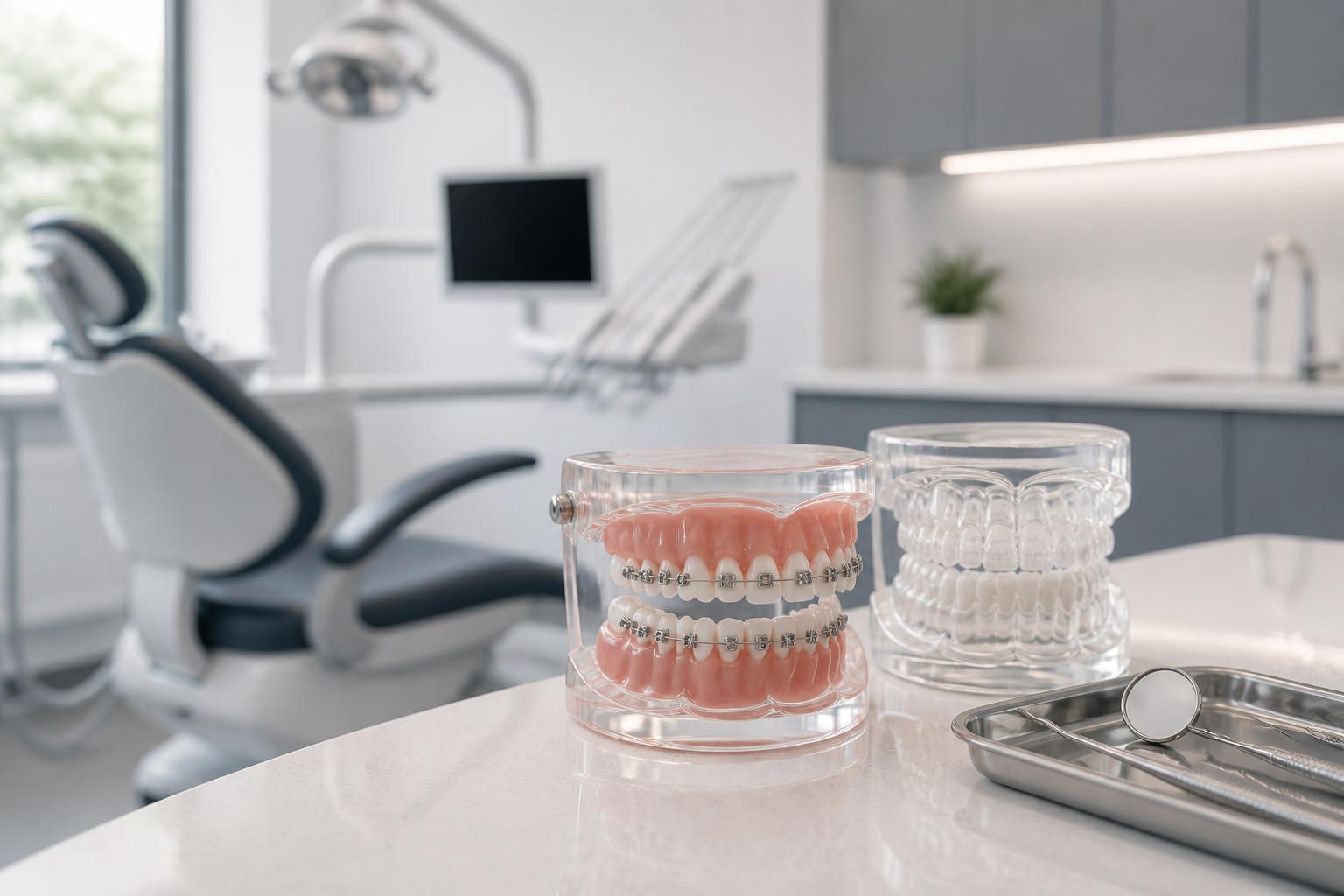
If your teeth feel crowded, your bite does not sit comfortably, or you avoid smiling because alignment looks uneven, orthodontic care can give you a clear path forward. At Biodent Clinic in 040039 București, Romania, we assess how your teeth meet, how your jaw guides the bite, and which treatment approach can support a steadier result.
Small alignment problems often become bigger daily annoyances, from food catching between teeth to difficulty cleaning around overlaps. The next step is a consultation where we look at your current position, discuss what bothers you most, and map out the orthodontic options that fit your case.
Orthodontic treatment is not only about appearance. It is often recommended when the bite, spacing, or tooth position makes everyday care harder or affects comfort while chewing and speaking. At Biodent Clinic, we look at the whole pattern, not just one crooked tooth, because alignment changes can influence several areas at once.
You may benefit from orthodontic care if you notice:
Some patients come for cosmetic reasons, while others want a more stable bite or better long-term oral care. Both are valid starting points. What matters is matching the treatment plan to the real issue.
BioDent Clinic treats orthodontics as a guided process, not a one-size-fits-all service. We begin by understanding what is happening now, what you want to change, and how much movement is needed to reach that goal. This helps avoid unnecessary treatment and keeps the plan focused.
Because orthodontic cases can involve more than alignment alone, we also consider whether other services may be relevant before or during treatment, such as profiling the teeth and gums, treating decay, or planning support for missing teeth when needed.
We review tooth position, bite relationship, available space, and visible areas that affect your smile. If your case involves crowding, spacing, or rotation, we identify whether the movement should be gradual and limited or more comprehensive.
Once we understand the issue, we outline the likely sequence of care, what the treatment is expected to address, and how the bite should be monitored over time. This gives you a realistic picture before you start.
Orthodontic cases vary widely, but certain patterns come up often. Some people notice that their teeth have shifted since childhood treatment was never completed. Others are dealing with crowding that makes brushing awkward. Some want to close spaces or improve the way front teeth show when smiling.
These concerns are common, but the right treatment differs from person to person. The plan depends on the current position of the teeth and how much correction is needed.
Orthodontic care can involve different types of appliances and monitoring, depending on the case. During your consultation, we discuss what is appropriate for your situation and how each option may influence comfort, appearance, and treatment time.
Depending on the plan, orthodontic treatment may include:
For some patients, orthodontics is combined with other services such as obturații, endodontie, parodontologie, or prosthetic planning, especially when the teeth need broader oral care before alignment work begins. That coordination matters because the mouth should be ready for movement before treatment advances.
People often delay orthodontic care because they are unsure what the process will feel like. In practice, the early steps are about understanding your teeth and building a plan that makes sense. Once treatment begins, the experience is usually built around scheduled reviews and steady changes rather than dramatic jumps.
We listen to what you want to change, check the alignment, and discuss the bite. If additional treatment is needed before orthodontics, we explain that clearly so you know the sequence.
During the active phase, the teeth are guided gradually. Visits are used to check progress, make adjustments, and keep the movement moving in the intended direction.
When the main movement is complete, the focus shifts to keeping the result stable and watching for changes over time.
Orthodontics often improves more than how teeth look in photographs. When teeth are better arranged, brushing and flossing can become easier because there are fewer tight, hard-to-reach areas. A more balanced bite may also reduce the uneven pressure that some teeth carry when chewing.
There is also a practical side that patients notice every day. Many feel more comfortable speaking, smiling, and eating when the teeth sit more evenly. For others, the biggest benefit is knowing that the correction addresses the cause of the problem, not just the visible part.
At Biodent Clinic, we keep the focus on outcomes that matter in real life, whether that means correcting crowding, improving spacing, or guiding the bite into a more workable position.
Good orthodontic planning starts before the first appliance is placed. If there are cavities, gum issues, or worn areas that need attention, these should be evaluated first. That way, the orthodontic plan is not interrupted by problems that could have been handled earlier.
It also helps to think about your goals ahead of time. Some patients care most about appearance, others about bite comfort, and many want both. Sharing those priorities helps us shape a treatment path that fits what matters to you.
BioDent Clinic serves patients at Splaiul Unirii 108, 040039 București, Romania, and appointments can be arranged by phone at +40752498601. If you are considering orthodontic care, this is the right time to ask what your teeth need and what kind of progress is realistic.
Orthodontic care can address crowding, spacing, rotations, bite imbalance, and certain shifting patterns that affect how the teeth meet and how easy they are to clean.
If your teeth look uneven, your bite feels uncomfortable, or cleaning around some teeth has become difficult, a consultation can clarify whether orthodontics is appropriate.
Yes. Depending on the condition of the teeth and gums, orthodontic care may be planned alongside other services such as fillings, gum care, endodontic treatment, or prosthetic work.
No. Many patients seek treatment for bite comfort, cleaning access, or shifting teeth, not only for the appearance of the smile.
The plan is based on your alignment, bite relationship, available space, and the changes you want to achieve. The goal is to match the method to the case, not force every patient into the same approach.
Yes. Adults often seek orthodontic care for crowding, spacing, or bite concerns, especially when teeth have moved over time or previous treatment was never completed.
Start Your Visit
Tell us what you need help with, whether it is a routine checkup, cosmetic improvement, or treatment for a dental problem. Our team can guide you toward the right next step.